(A data-driven investigative research project for Journalism Research Methods taught by Bastiaan Vanacker – 5/4/16)
Chicago is a culturally diverse city renowned for its versatility in food, art, architecture, and nightlife. Like other major cities dispersed throughout the country, Chicago has a rare opportunity for its bars to stay open later than most jurisdictions allow. By obtaining a Late Hour License from the Department of Business Affairs and Consumer Protection, bars and nightclubs are permitted to stay open past the typical closing time of 2 a.m.; instead, they can continue to serve alcohol until 4 a.m. on weeknights and 5 a.m. on weekends.
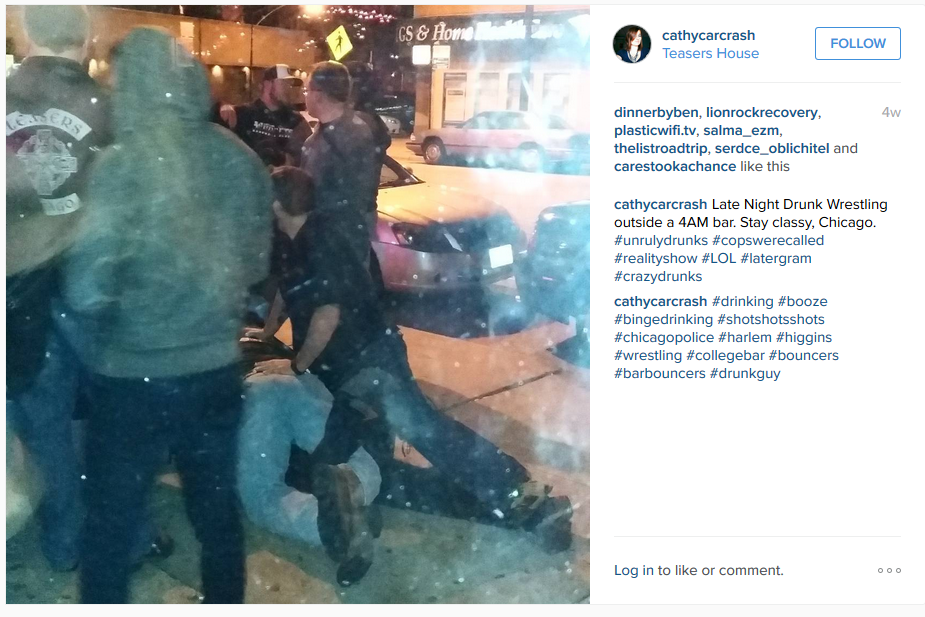
While this seems like a great way for businesses to bring in revenue with later hours and accommodate to those patrons who wish for their nights to be longer, a multitude of side effects result from these late night licenses. Chicago already has a high crime rate unevenly dispersed throughout the city, and providing customers an easier opportunity to be under the influence late at night puts them at a higher risk of becoming victims of assault, battery, or theft. A bar fight is also more likely to occur the longer a person stays out consuming alcohol and has been documented numerous times at different late hour bars throughout the city, according to reports by DNAInfo and the Chicago Tribune.
The side effects related to a bar closing later than the typical time of 2 a.m. are vital pieces of information for the public to be able to obtain for a multitude of reasons. First of all, it can showcase if there is a correlation between the location of a late hour bar and an increased crime rate in certain neighborhoods. This can affect where a person chooses to live, the safety factors of the neighborhood, and the property value in a specific location.
A young family looking to settle down may be swayed to look elsewhere if there is a higher percentage of aggravated assault or disorderly conduct in the neighborhood. Students moving to Chicago and living on their own may want to know if there are consequences as a result for living close to an area with heavy nightlife – as would their parents. Second, a person looking to invest in real estate may want to be able to analyze if the property value will fluctuate depending on surrounding businesses and amenities in the area. This type of study is important because this information has not been correlated together before and it is a useful resource that organizes numbers where there is not already a direct relation.
For my initial start, I began analyzing the annual crime reports made available through the Chicago Data Portal. Most readily available is the 2001-Current Crime Report that compiles all reported incidents into an Excel spreadsheet by type. There are an abundant amount of crimes that are not relevant to late night bars in Chicago so filtering by type of crime and whether an arrest was made breaks the information down further making it simpler to analyze. The filtering process can be broken down further by the location of the incident, so by eliminating locations other than bars and nearby public locations such as sidewalks and streets outside of bars, it becomes easier to determine exactly where and when these incidents are taking place.
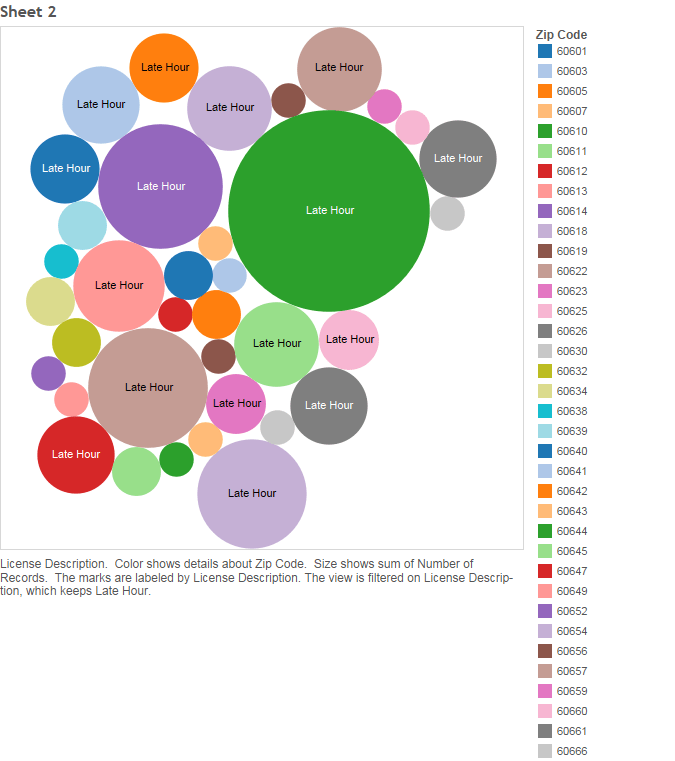
Another file available through the Chicago Data Portal is Current Liquor Business Licenses, which contains any business that is certified to carry and distribute alcohol by the Department of Business Affairs and Consumer Protection. Licenses such as packaged goods distribution and caterers’ liquor licenses can be filtered out as I am only looking at bars, venues, and nightclubs. This spreadsheet determines which bars are licensed for late hour liquor sales which will be useful when the data collected are plotted on a map.
By using a mapping resource such as CartoDB, I can plot the frequency of crime that occurs by type and overlay that with bars that are only open late night. Directly comparing this map plot with the frequency of crime that occurs at bars with regular closing hours, I can initially back up my presumption that more crime occurs at bars that remain open later. It becomes apparent that crime is denser in areas such as Lakeview, Logan Square, Bucktown, and DePaul where late night bars are more frequent compared to areas like Uptown, Pilsen, Ukrainian Village, and the Loop.
After discovering that the rate of crime is more frequent around neighborhoods with late night bars, I hope to discover the property values of homes in these areas to see how these numbers may be affected. As every neighborhood in Chicago belongs to its own homeowner’s association, I aim to both find stories that illuminate this issue and provide statistical proof. However, while searching for these numbers, it became more clear that while home value is available through real estate websites such as Trulia and Zillow (there is no report through Chicago Data Portal and neighborhood associations do not reveal rising or falling costs of properties in the area), I realized that many of the statistics available are for homes directly for sale and do not apply to rental properties. As much of Chicago is still rent controlled, it is hard to discover numbers that can support the claim of rising or falling property prices.

However, searching through academic and news sources shed light on a similar issue that has occurred in Portland with the appearance of both late night and wine bars in certain areas. In the areas of town where these businesses were emerging, property values began to rise as these locations were becoming more in demand. If there is any correlation, this could prove that Chicago property values were actually rising depending on the neighborhood (Logan Square property values have risen in the past three years with the issue of gentrification and emergence of more late night bars). Chicago Magazine analyzed which neighborhood values have increased and decreased since 2006 and presented the percentages in March of 2015, but there is no way to determine a correlation between bar emergence and their research. A way this could be proven is through in-depth analysis of property taxes and determining how they have fluctuated over the years. Unfortunately, this can only be done on a home by home basis and would be a lengthy process, but a possibility long term while pursuing this story.
In contrast to late night bars creating a draw for neighborhoods, a FOIA request to the Department of Business Affairs and Consumer Protection revealed the petitioning of local Logan Square residents against the approval of East Room, Ltd., from receiving a late hour liquor license. With two late hour bars already present on Milwaukee Avenue, residents spoke out in worry that another late hour bar would draw unwanted attention from a disruptive nature to the neighborhood. Two other bars, one located in Wicker Park and one located in the city’s distant West Side, were also denied due to residential petitions in 2013 and 2014 respectively due to worry of increased “rowdy activity” and worry of increased noise.
Further research of the neighborhoods that do have approved late night bars uncovered the fact that these bars do have an increased percentage of crime. According to DNAInfo, the frequency of bouncers being shot outside of late hour bars has gradually increased since 2006. Most recently, a bouncer was fatally shot outside of Brudder’s in Irving Park back in April. As a repercussion, the bar lost their late night licensing due to the result and are being asked to close early every night. Crocodile, a popular late hour bar in Wicker Park, has recently adopted a new code of “no gang-related, face, or neck tattoos” in order to keep their patrons safe after a street fight broke out outside of the bar back in 2014, causing damage to a nearby boutique. While they deem it as a safety precaution, many are accusing the bar of discrimination and unfair profiling.
However, they are not the only bar to adopt these new policies as bar violence is increasing throughout the city. Mayor Rahm Emanuel backed a “problem bar” ordinance that was approved by city council back in May of 2015 which allows the Chicago Police Department to close bars they believe to be a hazard to the neighborhood. This led to the closing of five “problem bars” and a gas station back in February, as city officials and the Chicago PD have noticed the increasing trend of assaults in bars. With the city taking action, it is clear there is a noticeable trend and a story here ready for publication.
Chicago residents and tourists have also taken notice of the increased drunken violence taking place around late night bars. A quick search on Twitter and Instagram revealed tweets and photos sourcing back to 2012 of bar fight documentation at establishments open until 5 a.m.
While there is a lack of solid evidence that late hour bars in Chicago may directly affect property value in neighborhoods throughout the city, it is clear that percentages of assault are increasing in correlation to the extended selling time of alcohol. This is not true for every neighborhood containing a late night bar, but it could unfold into a story highlighting certain areas of town with a changing demographic. This article could also combat the discriminatory views business owners are feeling pressured to make due to the rise in crime and lead to a safer method of managing bars.
 J. Tyler Holmes
Leave a comment